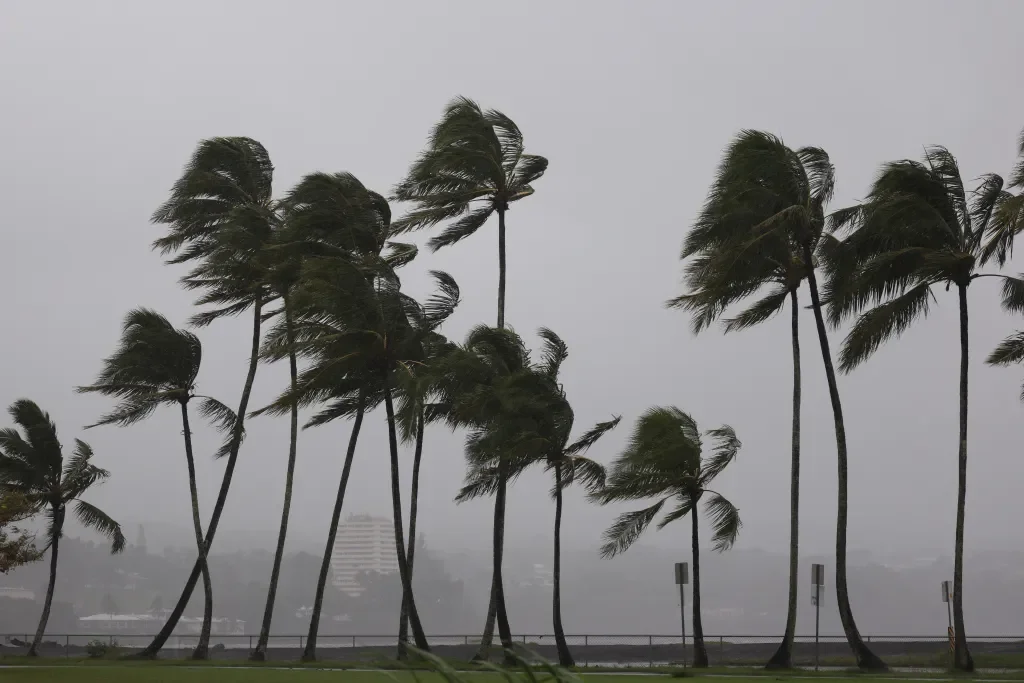
The name of the hurricane sounded to me like a chorus belting out musical scales. The wind churning in every direction through our Banyan, Pine, Mango, and Banana trees looked like the gymnastic arms of a symphony conductor. The torrential rain wafting through our cracked windows smelled of gardenia, pikake, and multiple Native Specie flowers.
In sum, maybe even in a potentially destructive and life-threatening hurricane we are able to find reasons to be grateful. Grateful, of course, for all our friends around the world who texted or emailed their fears and blessings on our behalf.
We – as in the singular, ‘Iokepa and I - were spared all but the loss of a couple lovingly nurtured papaya trees and a number of harmlessly-landing, enormous tree branches.
We - as the island of Kaua’i – the most Northwesterm of the Hawaiian chain were spared all but the truly impressive, awe-inspiring winds and rains for a single day.
We – as the collective Hawaiian Islands – were spared the fullest force of a hurricane whose destruction would have been immeasurable to the Island of Hawai’i, had the trajectory not missed by a blink and passed south of a direct hit.
And yet. There were Hawai’i-wide power outages, fallen trees across roads, houses, and cars, roof-tops un-roofed. And yet. A singular Island community, Ka’u – largely populated by Native Hawaiians among the least economically able to rebound – was flattened. A single life was lost.
I began this reverie about our Lala with a toe-tapping song. I do not end it with a dirge.
The community within the Ka’u district – perhaps the “poorest” among us – inspires. Without a blink, without a moment’s hesitation, Native Hawaiians behaved in the fullness of their culture.
It is a culture that Iokepa Hanalei ‘Imaikalani lives to reanimate as the authentic response to our global woes.
He speaks of the gifts of this ancient matriarchal culture awakening the wisdom – ritual and practices - that dissipate anger, prevent violence, foster harmony and share its profound implications for the 21st century.
And never was that more apparent than this past weekend in Ka’u. There, in the face of watching their tiny world splinter to a heap of physical rubble, the good folk of Ka’u lived, and continue to live, the example.
These folks stood in that ruble and behaved like a single organism - no one’s hurt, pain, hunger or joy was less than their own. They did no more than live the truth of their ancestors’ gifts: Ohana meant and means “Everything you can see is your responsibility to wrap your heart around and care for.” And that is never too much. The return is immeasurably circular.
How many times have I written a version of this story: Native Hawaiians seizing the gifts of their ancestors as naturally as breathing? These are a people who operate as a single organism – a genuine community. What pains one equally pains another.
This was not a gift given solely to these people in the middle of the Pacific. It is ours as well. It is our ancestral inheritance as well. Oh, but we do find ways to distract ourselves from what we know – and fail to use.
And so. This time, when the wind caused our trees to dance to the unheard music of Lala, I was able to feel the gifts. I was able to also feel the pain from Ka’u. But more than that, I felt gratitude for a people that continue to remind me that I can do better - and that my being better is a first step (maybe a more powerful one than standing with a protest sign on some street corner) toward healing a world that sorely needs it.